If there’s one element of architectural detailing that I appreciate beyond all others, it’s decorative tiling – among my most treasured possessions is Doug Rose’s incredible book, ‘Tiles of the Unexpected’, which provides an unrivalled study of the near-two million tiles that were fitted to the ticket halls, passages and platforms of the three deep-level Tube lines, the Bakerloo, Hampstead (Northern), and Piccadilly, as part of their construction between 1906 and 1907. The more intricate the pattern, the more ornate the overall scheme, the better – the most exciting part of any trip to London’s Criterion Theatre is rarely the performance itself, but the walk downstairs to the Stalls, past the magnificent Minton tiles, in all their original glory. Wandering around the incredible Food Hall in Harrods and it’s not the unrivalled selection of foods from each and every corner of the globe that amaze but the decorative tiles, visible behind the numerous counters. Perhaps most impressive of all, however is the V&A’s Gamble Room, where I recently had the pleasure of lunching, and upon arrival was duly mesmerised by the sheer ornateness of the space in its tiled entirety.
Millions of private homes and public buildings, hospitals, public houses and shops, particularly those built in the Victorian and Edwardian periods are lucky enough to still have their original tiling schemes on display, yet despite the move to protect and preserve our architectural heritage, millions of tiles still sit boarded or painted over, or worse still, have been lost forever, obliterated by unappreciative developers, whether private or professional, who seemingly fail to realise their unique value. Having both attempted to tile my own bathroom, and seen the inexcusable mess that they have made with so many London Underground stations in terms of poor workmanship (the over tiling of the Piccadilly line platforms at Russell Square being the best, or in this case, worst example), I am keenly aware as to how much of an art tiling is when done right.
Whilst the seemingly relentless closure of shops, and indeed public houses, is invariably viewed as a negative, and rightly so when small independent businesses, which in many cases have served their local communities over many years are pushed out by retail behemoths that bring little or nothing to the high streets that they are looking to serve (see Sainsbury’s Local/Tesco Express for details), one positive at least is the opportunity that often presents itself for the incoming business to strip back their new premises, which in some fortunate instances can reveal the original interiors. One glorious example of this is occurring right now at 224 Muswell Hill Broadway, N10, where the long-standing Supersave Food & Wine has recently closed, and is set to be replaced by a branch of Greek restaurant chain, ‘The Real Greek’. It had been impossible to see in to the shop since its closure, owing to its complete covering with posters, whilst more recently a temporary wooden structure has been erected in order to secure the building before the new shop front is installed. A couple of weeks ago, however I happened to be in the right place at the right time, so as to walk past when the door was open, and so caught a glimpse of the empty space inside.
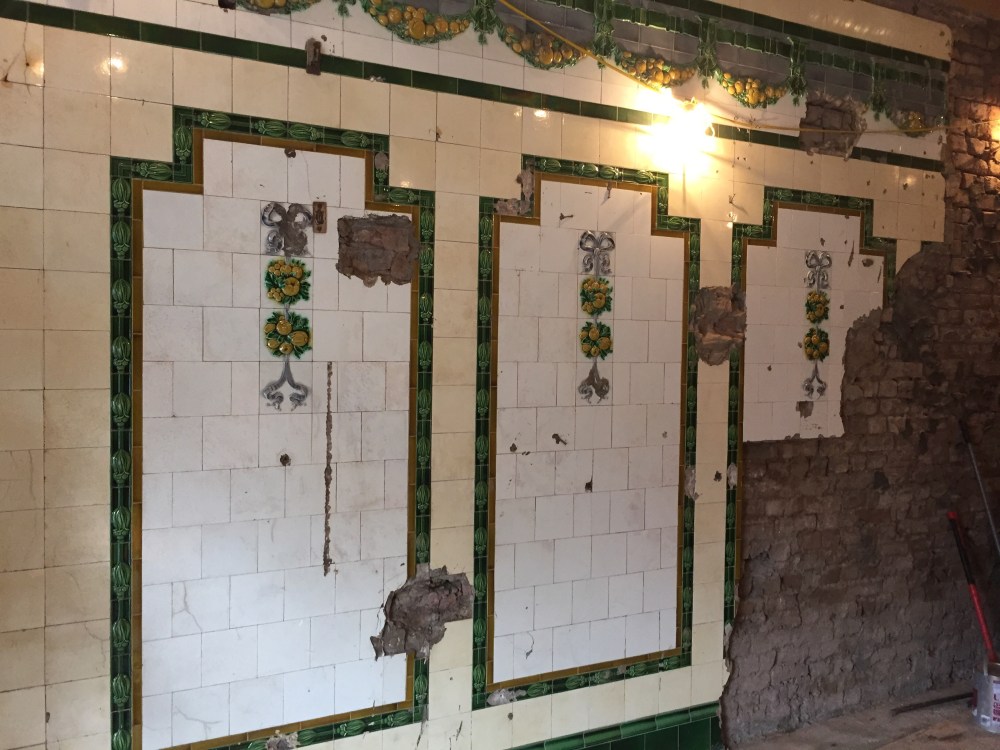
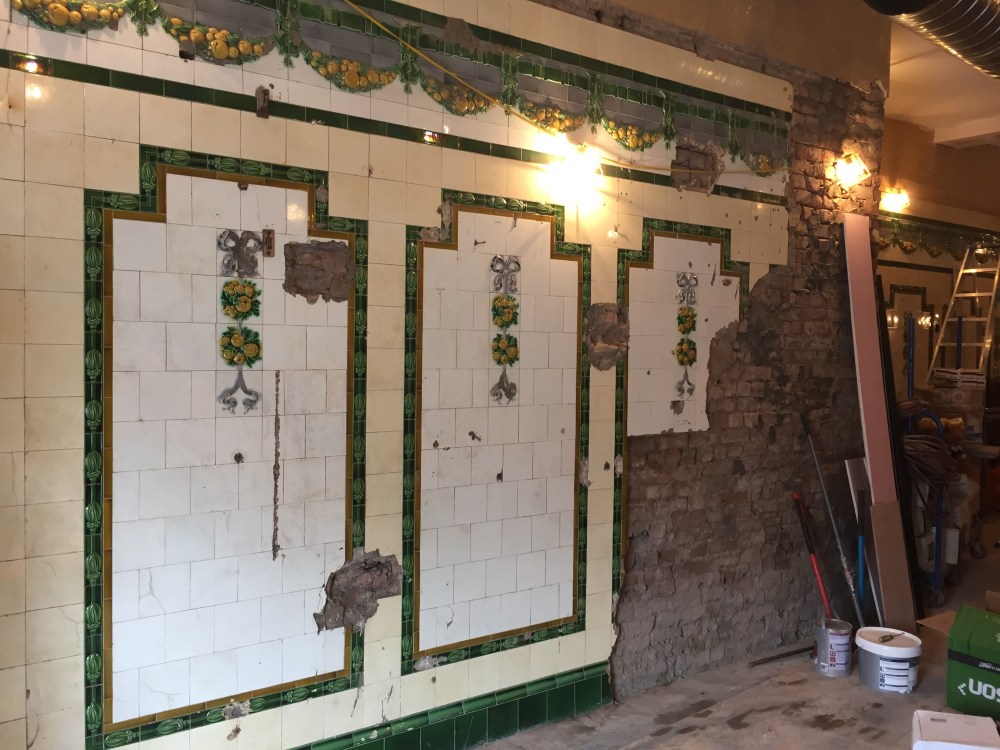
For those that can remember Supersave, it was a pretty tired but altogether typical convenience store interior, complete with floor-to-ceiling steel shelving units and strip lights throughout. What has subsequently been revealed, however is the original tiling from when the shop first opened in the early 1900’s. Whilst I haven’t been able to find out exactly what the building first served as, the cream and white tiling scheme, with green skirting tiles and ornate fruit detailing could point to it having been a grocers shop. Whilst the entire right-hand side of the shop appears to have lost its tiling, if indeed it was ever tiled, much of the left-hand side remains, and does so in remarkably good condition given its age, aside from several areas of obvious damage, most likely caused by the installation of brackets required to support the previous shelving units. Worryingly, however was that among the two workmen on site whilst I was present, there was some disagreement as to whether the tiles were staying with one saying that they were going but the other claiming that the surrounding brickwork was to be rendered and the remaining tiles left in situ.
Clearly, I am very much hoping for the latter outcome, and for ‘The Real Greek’ to incorporate the glazed tiling in to their new restaurant design, but should these wonderful tiles be mercilessly hacked away, at least there are now photographs of what were once there – enjoy.

 The New Wipers Times