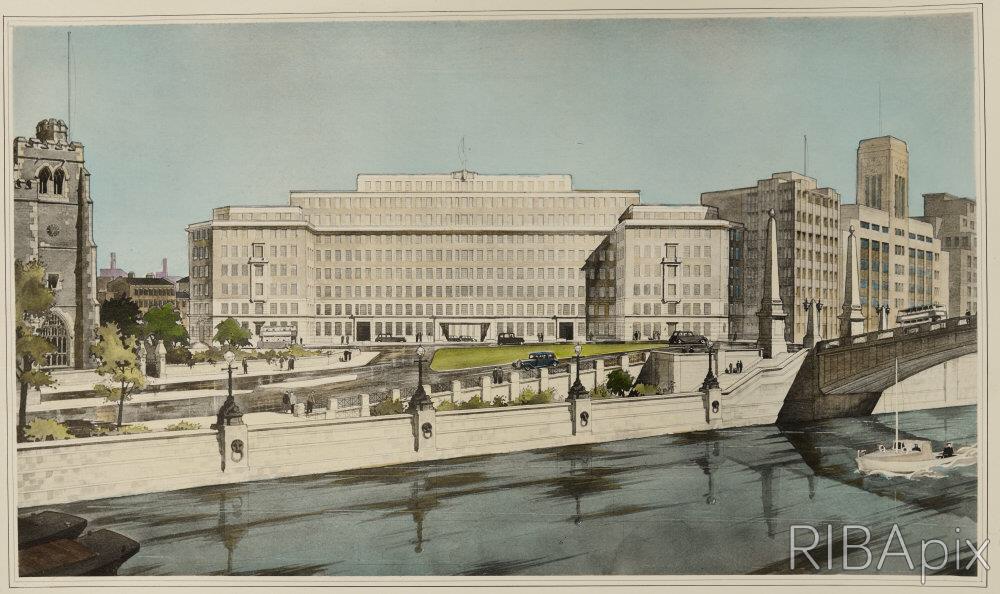
‘Lambeth Bridge House’ was the largest office block in Europe when it opened in the autumn of 1940, at the height of the Battle of Britain. It managed to survive the Blitz intact and stood for another 60 years, serving as government offices throughout, before being demolished in the late 1990’s and replaced by apartments.
Situated at the north end of the Albert Embankment, the new office building stood directly overlooking the Houses of Parliament, with Lambeth Bridge immediately to its left and the historic Lambeth Palace to its right. It was the last of four notable buildings to be erected along this particular stretch of the River Thames, all on land previously owned by the ceramics manufacturer, Doulton & Co., which was disposed of during the 1930’s, as production was transferred out of London.
Originally set to be known as ‘Embankment House’, the more appropriately named, ‘Lambeth Bridge House’, as the building became known, was designed by the architects, Howard and Souster, with plans drawn up under the direction of E. G. Souster himself in 1938. The partnership were prolific during the 1930’s, specialising mainly in commercial and industrial work.
Also responsible for the similarly named, and styled, ‘Waterloo Bridge House’, at 57, Waterloo Road, S.E.1., another office building that is now occupied by King’s College London, Howard & Souster are, perhaps, best remembered for the ‘Art Deco’ Rootes car showroom and workshops in Maidstone, a Grade II listed building since 1st October,2009.
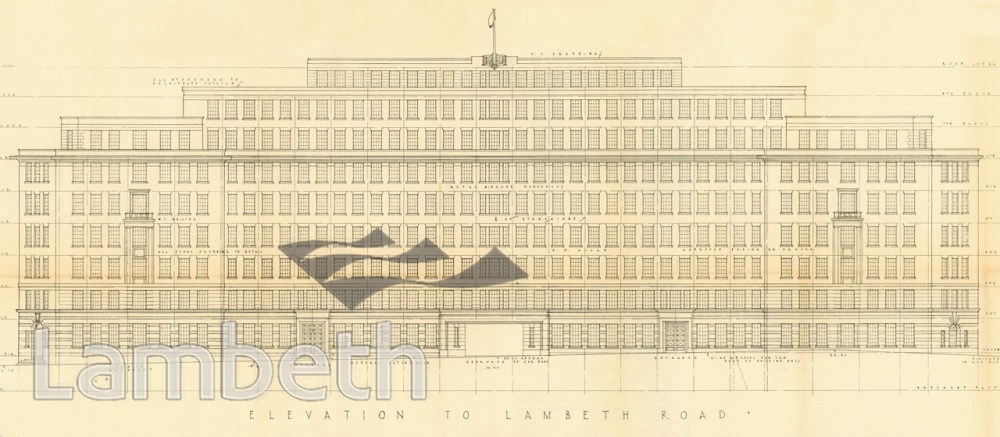
At ‘Lambeth Bridge House’, Souster designed an imposing, nine-storey building, which given the nature of the large corner site, featured two principal elevations, one on the Albert Embankment and a second on Lambeth High Street, allowing him to both maximise the amount of available office space and provide the speculative development with a high degree of flexibility should it be needed.
For construction of the new office building, the established firm of Richard Costain, Ltd. were appointed as general contractors, with building work commencing on 1st June, 1939. Despite the interruption of the Second World War, construction took just over a year, reaching practical completion on 24th June, 1940.
As with several other buildings that were designed with the shadow of war looming, yet subsequently opened in 1940, the exterior at ‘Lambeth Bridge House’ lacked both the design flair and high quality materials that its earlier neighbours all exuded, instead making use of artificial Portland stone and silver-grey facing bricks, rather than glazed terra-cotta.
As such, the new building could be more accurately described as ‘Austerity Deco’, rather than ‘Art Deco’, with even Pevsner fooled, describing ‘Lambeth Bridge House’ as being “of the 1950’s”, a nod to the plain exterior, which he saw as “brick, utilitarian and indifferent”, or “Stalinist” as another commentator described it.

Given the wartime backdrop, the building’s primary appeal in late 1940, beyond its obvious size, was likely its reinforced concrete basement, providing protection against the daily threat of air-raids. As a result, ‘Lambeth Bridge House’ was immediately occupied by the Ministry of Works and Buildings, led by Lord Reith, among whose first jobs was to establish a cement committee in January, 1941.
Above the concrete basement, the upper floors were all steel-framed. Redpath Brown & Co., Ltd., provided the steel, which can be seen rising in the photograph below, taken from the rear of ‘Doulton House’.

Across the exterior, cast Portland stonework, supplied by Girlings’ Ferro-Concrete Co., Ltd., was used up to the first floor, at which point facing bricks from Greenham, Ltd., took over, used for the second to seventh floors and pointed with a silver sand mixture. For the eighth, and final floor, the architects reverted to stone.
Artificial stone was also used for dressings and cornices, as well the window sills, within which sat metal casements from W. James & Co., Ltd., with glazing supplied by Aygee, Ltd.
Unlike at neighbouring ‘Doulton House’ or the ‘London Fire Brigade Headquarters’, there were no decorative friezes or reliefs commissioned at ‘Lambeth Bridge House’, reflecting the fact that the building was initially a speculative development. At ground floor level, the only notable decoration was the building’s name, which was carved above each of the three entrances, by Gilbert Seale & Son., Ltd.
A large car park was built at the rear of the building, access to which was via a ‘drive-in’, on the Albert Embankment elevation. To accommodate this, the main elevation was recessed, which provided the necessary space for a small service road at the front. A similar ‘drive-out’ led directly on to Lambeth High Street at the rear.
In contrast to ‘Bridge House’, where the main entrance to W. H. Smith’s warehouse was positioned in the centre of the Albert Embankment elevation, and flanked by a pair of vanways, at ‘Lambeth Bridge House’, the drive-in itself took centre stage, with the entrance doors placed either side. A smaller third entrance was also provided on the Lambeth High Street elevation.
Immediately inside the main block were the lobby areas, with staircases, on the right hand side, and a pair of lifts on the left, the latter supplied by Penrose Lifts, Ltd., with lift landing doors from Caston & Co., Ltd. Lavatories were positioned behind the lifts, the sanitary fittings for these being provided by W. N. Froy and Sons, Ltd.
The service areas were replicated on each of the floors above, having been designed so as to allow for the office space to be subdivided should the occupier/s require it. As it was, the Ministry of Works and Buildings took all of the available space.
‘Lambeth Bridge House’ occupied the most prominent, and arguably therefore, the most important site on the Albert Embankment, yet of the four new buildings erected in the 1930’s, it was undoubtedly the most disappointing in terms of architectural ambition and merit.
That view most likely reflects the fact that the office building was the only one not to be purpose-built by its owner-occupier, and as such, it lacked the unique design, detailing and materials displayed elsewhere, including on other notable buildings of the era, such as ‘Unilever House’ or London Underground’s ’55 Broadway’, both built solely for occupation by the firms that commissioned them.
Few speculative office buildings of the 1930’s have survived and it is noteworthy too that both ‘Bridge House’ and ‘Doulton House’ were demolished soon after their original occupiers departed. Had they remained, there might have been a case for saving ‘Lambeth Bridge House’, if only to maintain the historic setting.
As it was, ‘Lambeth Bridge House’ was never listed and given its prime riverside position it was always likely to be an obvious candidate for redevelopment. The building was demolished in the late 1990’s and replaced by EPR Architects’ ‘Parliament View Apartments’.
January, 2019.
 The New Wipers Times
3 Comments Add yours