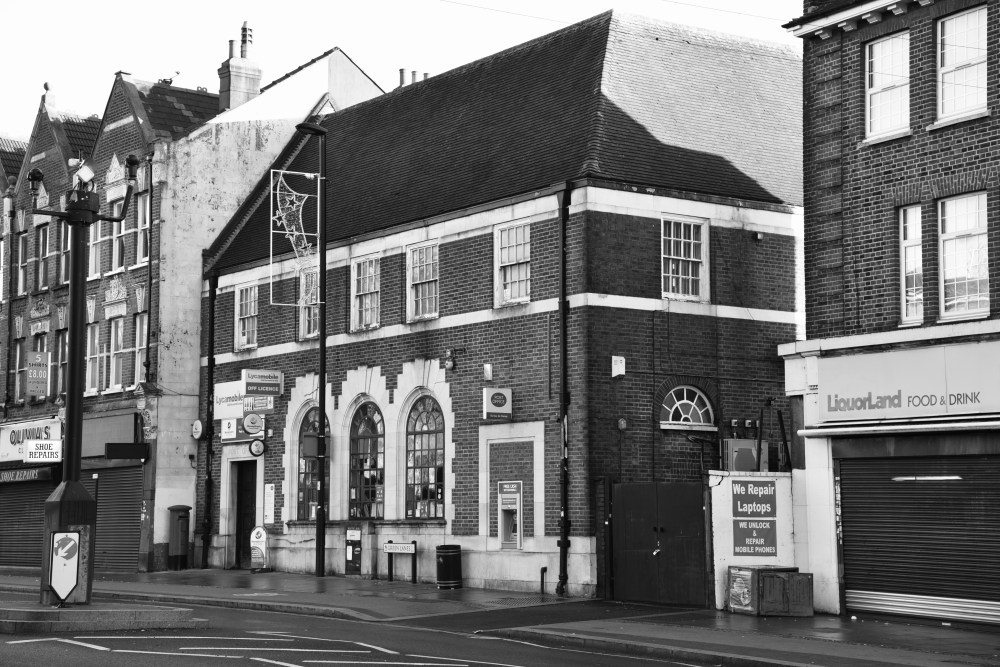
Today’s photographs are of ‘Palmers Green Post Office’, which stands at 364, Green Lanes, N.13, directly opposite the junction with Fox Lane. Sadly, like so many public buildings in towns and cities across the UK, its current appearance betrays both its original presence and splendour, having been compromised by unfortunate additions, principally in the form of modern signage.
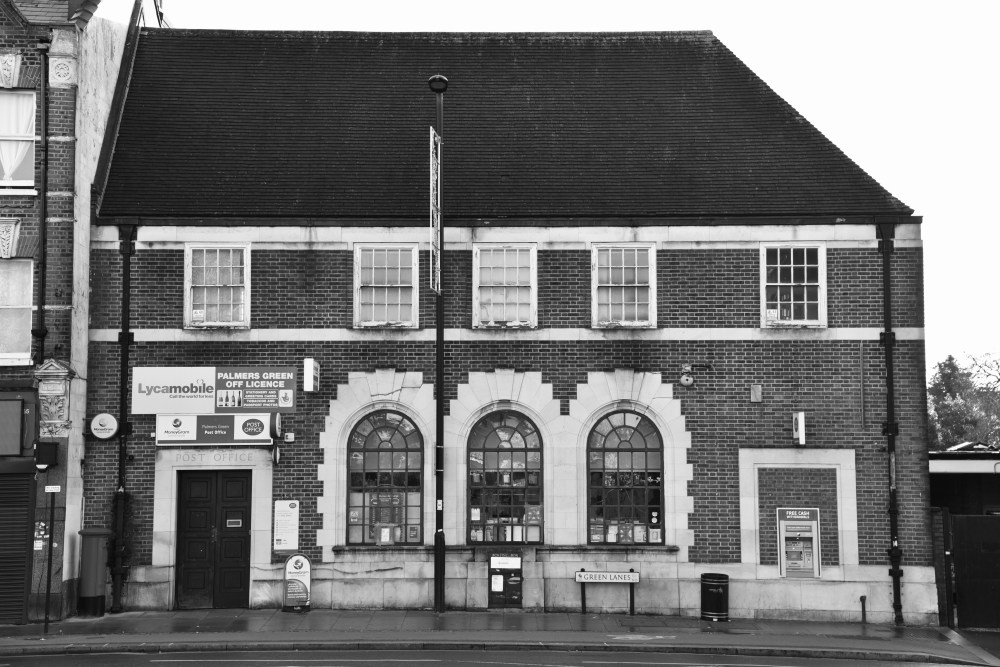
With the rise of email and electronic banking having reduced the need for many existing counter services, numerous Post Office closures have taken place in recent years, yet Palmers Green, now in its 87th year, has always managed to escape the cuts and still serves its original purpose, for the same company that it was built for, an increasingly rare feat for buildings of this age.
The new building was reportedly opened on 1st January, 1932, which might seem somewhat illogical today, yet should be placed in the context of New Year’s Day not having been a public holiday in England until 1974. It replaced an earlier Edwardian sorting office from 1906, with the Post Office Circular of 13th January, 1932, confirming its designation as “Palmers Green, Green Lanes, B.O.” (Branch Office), whilst also noting the closure of a second, smaller Post Office “near Railway Stn.”
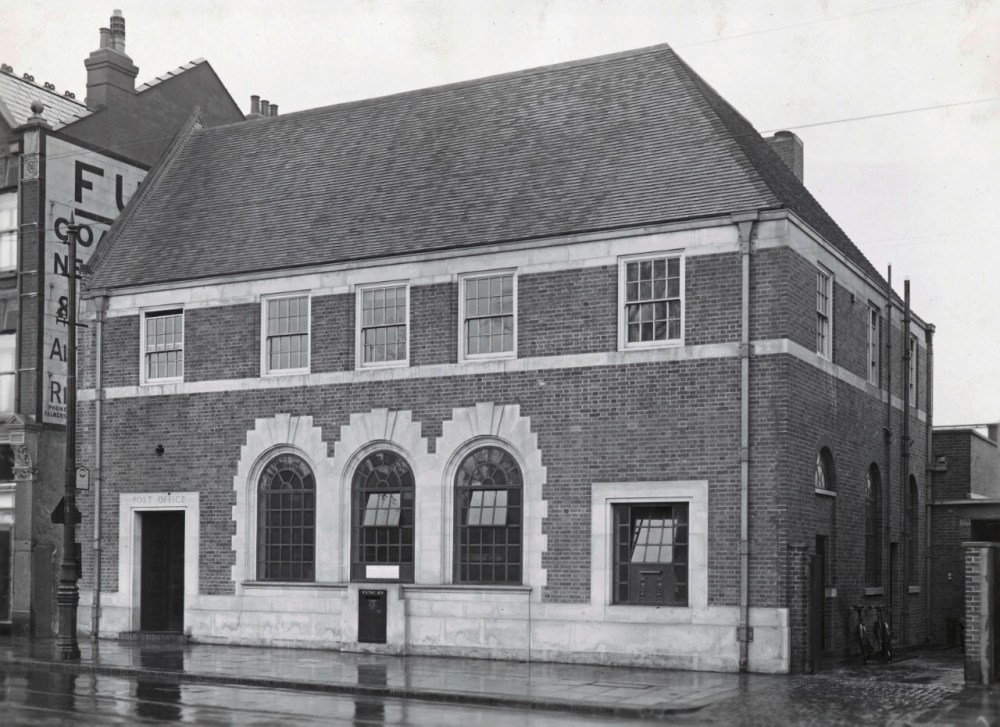
Designed in the early 1930’s, at a time when classical architects were still seeking to fend off the rise of the modernists, with their clean lines and curves, ‘Palmers Green Post Office’ unquestionably stands as a monument to the classicists. Typical of many interwar buildings of the era, with its traditional red brick facade, it would now be described as Neo-Georgian in appearance, a popular architectural style of the early 20th century, and one that has seen both a reappraisal and renewed appreciation in recent years.
The building was a product of the Office of Works and is one of many new purpose-built Post Office buildings to have opened in the 1930’s, most of which express a similar design language to that of Palmers Green, including nearby Muswell Hill. Central to that theme is a strong sense of symmetry in its exterior design, with the principal Green Lanes elevation made up of five separate bays. Despite an exhaustive search, I have, as yet, been unable to attribute the design to a specific architect.
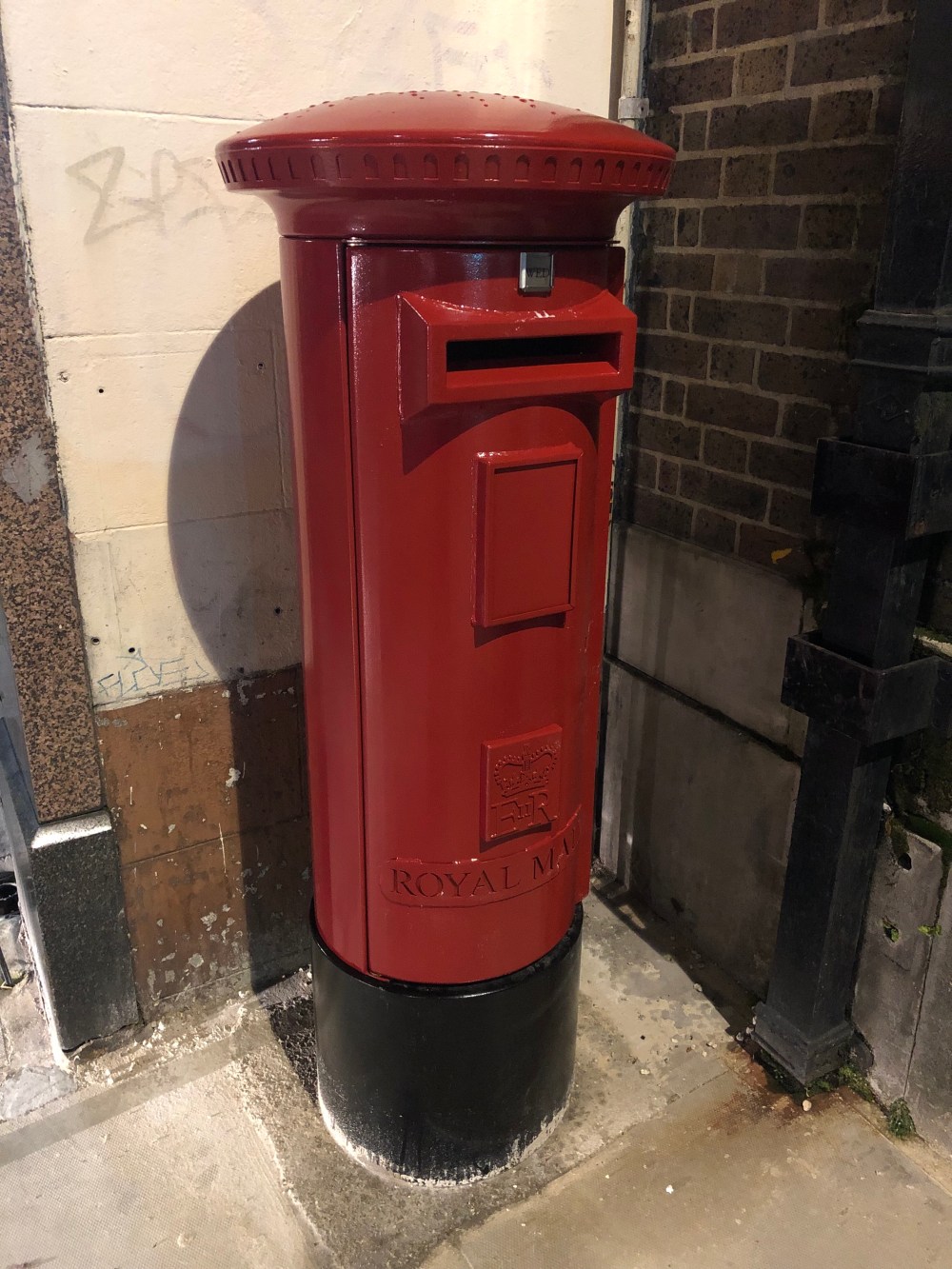
At street level, three arched metal windows each sit within a decorative Portland stone surround. Beneath the middle window is an attractive cast iron ‘Posting Box’, which is sadly no longer in use, having been replaced by a red pillar box in December, 2018, and subsequently screwed closed. Elsewhere, several panes of glass have been broken and crudely covered with brown tape and cardboard, rather than being properly repaired, leaving the facade looking in need of attention.
Cast iron gutters frame the building at each end, with the centrally located windows flanked by the main entrance door to the left hand side, and what was once another window to the right, both of which also feature a matching stone surround. The right hand window was bricked up last year to allow for the installation of an ATM, and whilst done sympathetically, matching both the original red bricks and the Flemish bond repeating pattern used in their construction, the cash point itself ultimately detracts from the original facade.
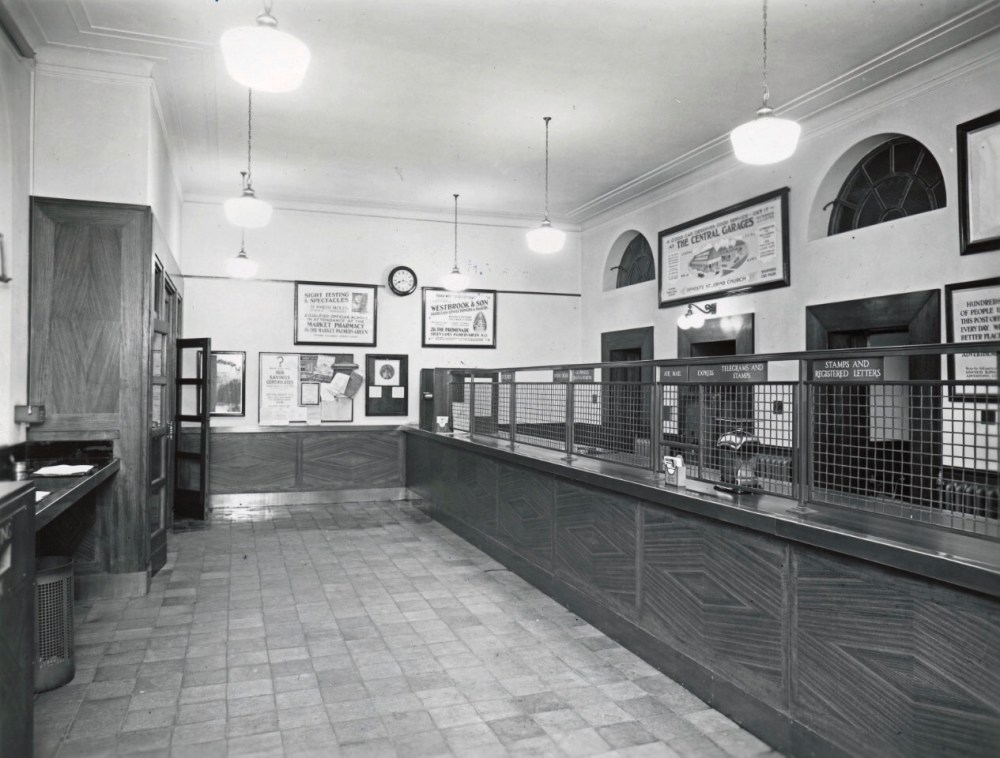
At first floor level, five sash windows sit directly above each opening, and whilst they are all original, they are now in a very poor condition, with peeling white paint. With seemingly no thought for the building behind, Enfield Council have also cited a large lamp post directly in front of the Post Office, itself featuring a poorly placed sign for ‘Traffic enforcement cameras’, another notable detractor from the original facade. Internally, there is no visible evidence left of the period interior, with the other side of the ‘Posting Box’ having been covered by modern shelving units. Sadly, everything else has simply gone.
Thankfully, the rest of the exterior alterations are merely superficial, although the changes are still numerous and collectively they create the most visible damage – the original signage, whose beauty lay in its simplicity, with the words ‘Post Office’ carved in to the stone surround above the entrance door, has been marred by clumsy modern additions, all of which severely detract from the attractive period frontage, including various projecting signs, all of them advertising services within, which have been added in an entirely ad hoc manner in recent years. The Post Office itself has recently been subdivided and joined by the Palmers Green Off License, who have also chosen to erect a large and unsympathetic sign above the main entrance.
It is exactly this sort of visual clutter on buildings that local councils could, and indeed, should be far more proactive in discouraging, instead introducing and encouraging design principles and/or standards for businesses to adhere to. Initiatives such as that by Waltham Forest Council on Leyton High Road, show the dramatic improvements in streetscape that can be achieved. Funded by the Working Neighbourhoods Fund, the east London scheme included specialist conservation work and provided new signage, new shop front facades, new shutters, and painting.
‘Palmers Green Post Office’ has never been considered for listing by Heritage England, which is understandable, as it is not necessarily of special architectural or historic interest at a national level, however disappointingly, neither has it been recognised on Enfield Council’s Local Heritage List, which acknowledges buildings of special local interest.
Its loss would be quickly realised, however, as the building undoubtedly adds to the character and appeal of both the immediate high street and the broader area of Palmers Green, the architecture of which is almost exclusively Edwardian, with a smattering of postwar additions and replacements. It is no coincidence that the most successful high streets typically feature well maintained shop fronts that often seek to incorporate original features, rather than hide them, fighting back against the repetitive anonymity of chain stores. With this in mind, both ‘Palmers Green Post Office’, and its neighbours can surely do better.
February, 2019.
 The New Wipers Times