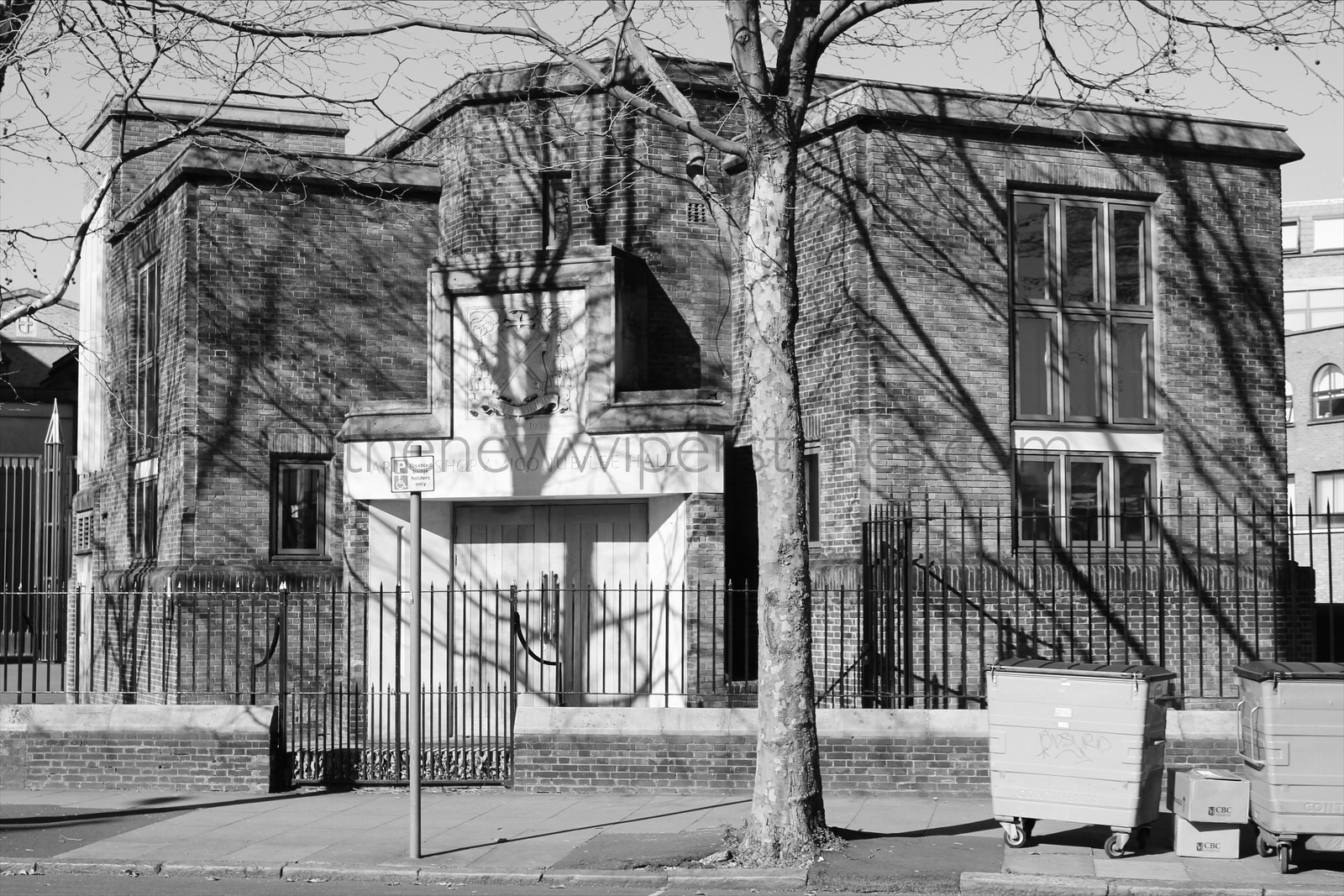
Today’s photographs are of the Parish hall for Saint George’s Cathedral, which was opened in 1940 to commemorate Archbishop Amigo’s golden jubilee in the priesthood. Located on Lambeth Road, S.E.1., the small, unassuming building stands within the grounds of the Cathedral itself, which was originally designed by Augustus Pugin (1812-1852), opened in 1848 and remains the Cathedral Church of the diocese of Southwark.

The ‘Amigo Hall’, as it is known, was designed by the Scottish architect, Robert Sharp, F.R.I.B.A. (1881-1950), who commenced practice in 1906, having been articled to J. A. Ogg-Allan of Aberdeen. Sharp was tasked with creating a suitable space for diocesan events and as such the two-storey building centred around a large assembly hall and stage.
At first floor level, reinforced concrete balconies ran down both sides of the hall, complete with wrought iron balustrades in an ‘Art Deco’ style, sourced from Shinkfields, Ltd. Folding screens were used to separate a pair of adjacent club rooms, which could be opened up for larger events, with similar oak partitions also used to separate both the stage and dressing rooms at the rear.

Working from offices in Westminster, Sharp appears to have specialised in motor garages and showrooms, with his best preserved work being that of 350, Kings Road, S.W., new business premises for the Blue Bird Motor Co., Ltd. The Grade-II listed ‘Art Deco’ building is better known today simply as ‘Bluebird Chelsea’, part of the D&D London restaurant chain.

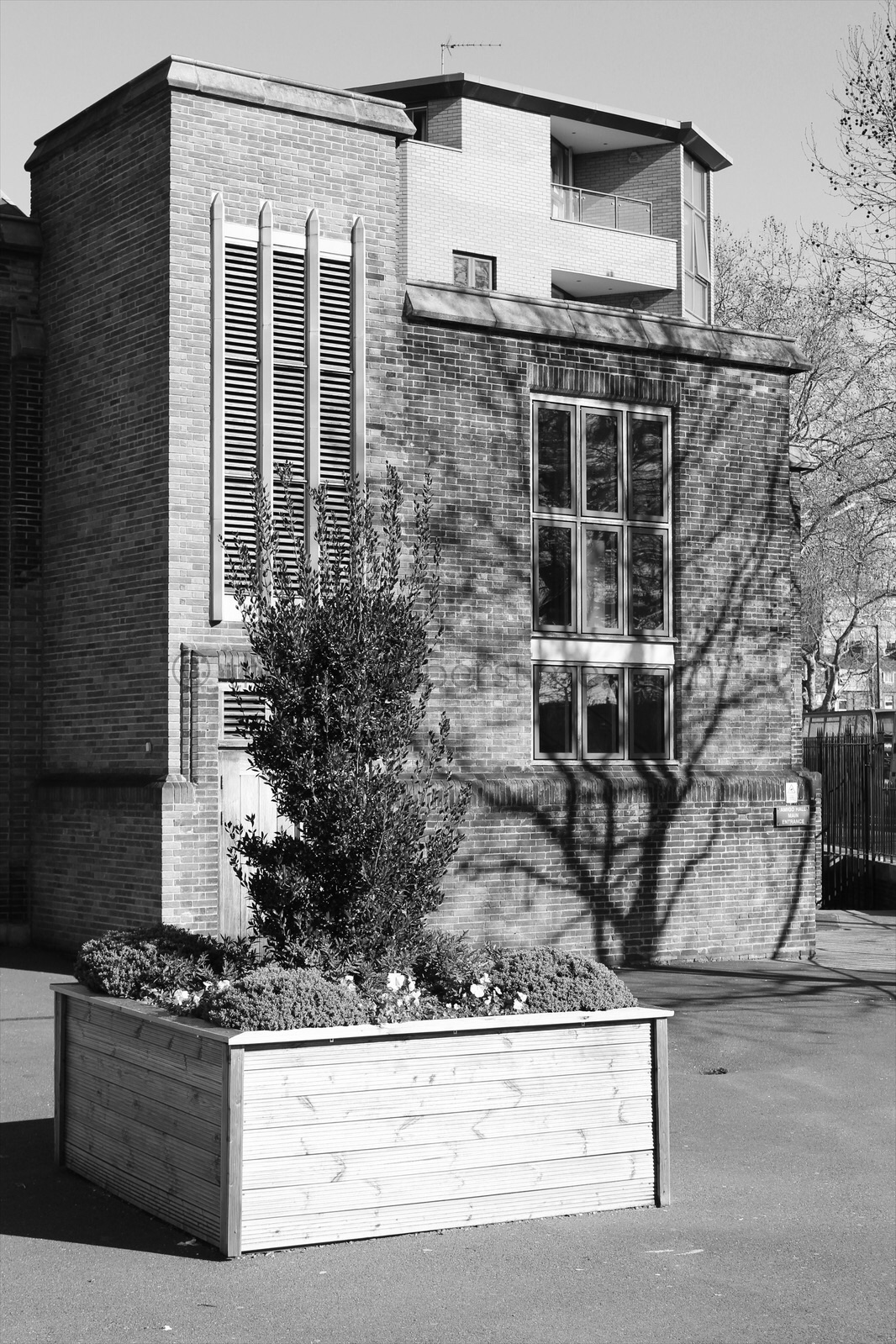
W. J. Mitchell and Son, Ltd. were appointed as general contractors on the new hall, which cost more than £7,000 to build. Boulton & Paul, Ltd., supplied the structural steel for the building’s part-steel frame, which was then finished with 2-inch Leicestershire grey facing bricks from J. P. Walshe and Sons, Ltd., and artificial Portland stone from Blokcrete Co., Ltd., which was used for coping and dressings.
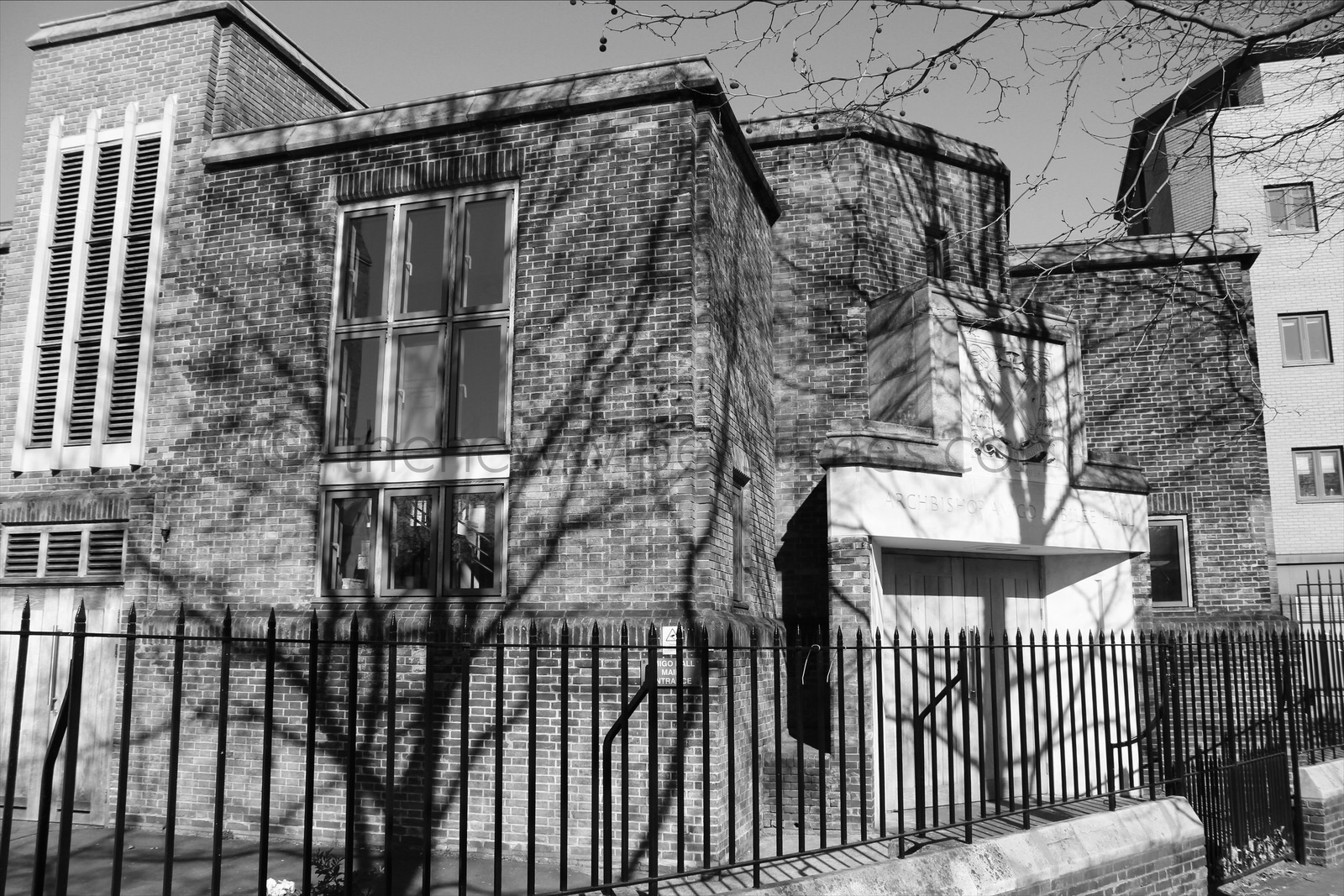
High quality materials were used throughout the building, with Westmorland green slates used to cover the roof, and maple strip hardwood for the floors, sourced from Hollis Bros. & Co., Ltd. For the windows, standard metal casements from C. W. James & Co., Ltd. sat within natural oak surrounds, with lead glazing from Lenscrete, Ltd., who also provided the glass roof.
On 3rd February, 1940, the completed hall was blessed and opened by Archbishop Amigo, just seven months before the start of the Blitz, the German bombing campaign against London. Sadly, St. George’s would not escape unscathed and on the night of 16th April, 1941, Pugin’s Cathedral was almost completely destroyed by incendiary bombs during a particularly heavy raid on the capital.

With little more than the outer walls still standing, the parish hall assumed the status of pro-Cathedral, a role that it performed admirably until 1958, when the post-war rebuilding of the original Cathedral was completed, to a design by Romilly Craze (1892-1974).
Today, the hall still stands largely as built, marred only by an unusual choice of red-framed replacement window casements and the loss of the original led glazing. The windows were replaced as part of an extensive refurbishment programme, which was completed in 2009, nearly 70 years after the building was originally opened, and included the demolition of a 1960’s extension at the rear of the hall.
April, 2019.
 The New Wipers Times
2 Comments Add yours